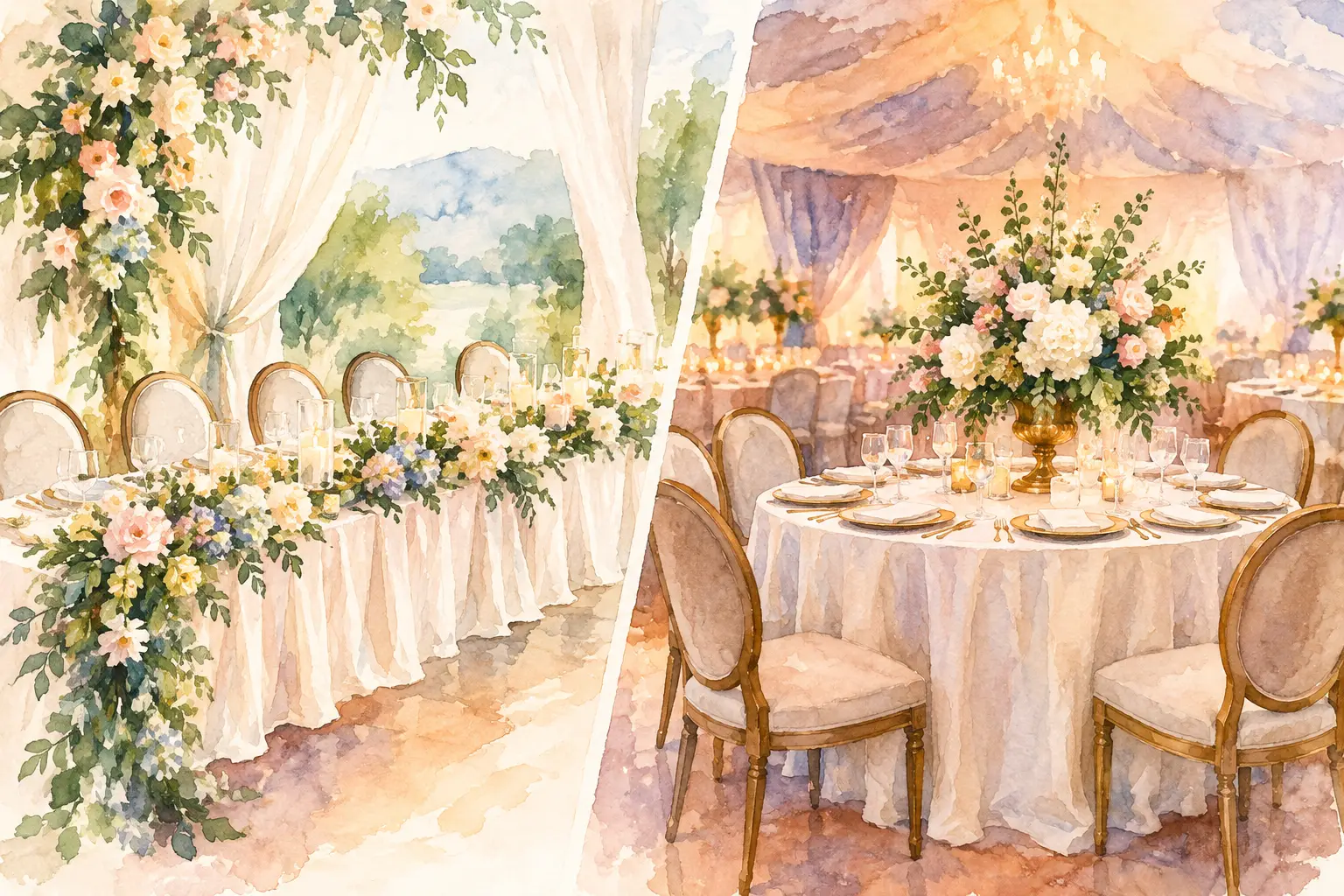
The table at the front of a wedding reception does more than seat the couple. It gives the room a visual center, sets the tone for photographs, and helps guests understand where to look when they enter. When considering a head table versus kings table, the right choice often comes down to the atmosphere you want to create and how you want your décor to carry through the room.
Both options can be beautiful. A traditional head table creates a defined focal point for the newlyweds and wedding party, while a king’s table brings everyone together at one long, shared table. The difference may sound simple, but it affects the scale of your florals, the balance of the reception layout, and the feeling of the celebration.
What Is a Traditional Head Table?
A head table is typically a rectangular table placed at the front of the reception space. The couple sits in the center, often with members of the wedding party seated alongside them. Guests are usually seated at separate guest tables facing or angled toward the head table.
Visually, this arrangement creates a clear moment of attention. It gives the couple a dedicated backdrop for the evening and provides a natural place for elevated florals, candles, draping, a stage treatment, or a statement focal display. In a ballroom or larger reception room, that defined front-of-room presence can help the space feel intentional rather than scattered.
A head table also gives décor an opportunity to build upward and outward. A lush floral runner, layered candlelight, textured linens, or a full backdrop behind the table can create a polished scene without repeating the same level of detail across every guest table.
When a head table feels right
A head table is often a lovely choice for couples who want a classic reception look or who have a larger wedding party. It works especially well when the room has a natural front wall, stage, sweetheart backdrop, or architectural feature worth highlighting.
It can also be the better visual choice when you want the couple’s seating area to feel distinct from the guest tables. If the rest of the room features low centerpieces and candlelight, the head table can carry fuller florals, more layers, or a bolder color story while still connecting to the overall design.
There is a trade-off, though. A long head table can sometimes feel formal or separated from the rest of the room, particularly in a smaller venue. The key is to make the table feel welcoming rather than isolated, using décor that echoes the guest tables and draws the eye across the entire space.
What Is a King’s Table?
A king’s table is a long banquet-style table where the couple, wedding party, and sometimes close family members sit together. Rather than creating a separate front-facing table, it places the people closest to the couple in one shared setting. Depending on the guest count and venue layout, it may sit at the center of the reception or run through the room as a major design feature.
The effect is warm, connected, and visually generous. A king’s table can feel like a beautiful dinner gathering, even within a large celebration. It is especially striking when dressed with a continuous floral runner, clusters of candles, carefully chosen place settings, and layered table linens.
Because the table is longer, it naturally asks for rhythm in the décor. Instead of one large centerpiece in the middle, the design may use repeating floral moments, low arrangements, bud vases, taper candles, or greenery placed in a way that feels full without blocking conversation. The eye should travel easily from one end of the table to the other.
When a king’s table feels right
A king’s table suits couples who want their reception to feel communal and less traditional. It can be particularly meaningful when family connection is central to the celebration, or when the couple wants to sit among loved ones rather than apart from them.
It is also a wonderful option for intimate weddings, long reception rooms, and celebrations where tablescape details are a major part of the design. For cultural celebrations, a long family-style table can create a strong visual anchor while leaving room for décor that reflects the colors, textiles, florals, and meaningful details of the occasion.
Still, the scale needs careful attention. A king’s table can become visually heavy if the centerpieces are too tall, too dense, or too repetitive. It also needs enough space around it so guests and staff can move comfortably. A thoughtful table design should feel abundant, not crowded.
Head Table Versus Kings Table: The Visual Differences
The main difference between a head table versus kings table is where the visual emphasis lands. A head table concentrates attention in one place. A king’s table spreads that attention across a longer, more immersive tablescape.
With a head table, the backdrop often plays a larger role. This might be a floral wall, soft draping, a layered focal display, or a clean architectural wall framed with florals and candlelight. The table itself can be richly styled, but it is usually part of a larger front-of-room composition.
With a king’s table, the table is often the composition. Guests notice the runner, the chairs, the linens, the floral placement, the glow of the candles, and the repeating details along its length. A backdrop can still be beautiful, but the table needs enough presence to stand on its own.
Color works differently as well. A head table can carry a deeper or more dramatic version of the wedding palette, with guest tables using lighter coordinating accents. A king’s table usually benefits from a color story that unfolds gradually, such as ivory florals layered with soft blush, warm gold candleholders, and touches of greenery from end to end.
How Centerpieces Should Change With Each Style
Centerpieces should support the seating style, not compete with it. For a head table, one continuous low floral arrangement can create a refined finish across the front edge. Alternating floral clusters and candles can also work beautifully, especially when the backdrop already provides height and fullness.
For a king’s table, think in sections rather than a single centerpiece. The goal is to create movement along the table. Low floral groupings, small vase arrangements, taper candles, and occasional raised pieces can add dimension while keeping sightlines open for conversation and photographs.
Tall centerpieces can work with either option, but placement matters. At a head table, they may be more effective at the ends or behind the seated group, where they will not block faces. At a king’s table, tall designs are best used sparingly and with clear space between them. The people at the table should still be able to see and speak with one another comfortably.
Consider the Reception Room Before Deciding
The room should help guide the choice. A reception space with a built-in stage or a dramatic focal wall often lends itself naturally to a head table. A long, narrow room may look especially balanced with a king’s table running through the center or positioned as a feature near the dance floor.
Ceiling height, lighting, chair style, and table shape all influence the final look. In a room with lower ceilings, a low and layered tablescape can feel more elegant than oversized arrangements. In an open ballroom, a head table with a fuller backdrop may help create warmth and definition.
For Greater Boston weddings and celebrations, venues can vary widely, from grand ballrooms to airy lofts and intimate function spaces. The most successful choice is not always the trendiest one. It is the one that gives the décor room to breathe and makes the reception feel connected from the entrance to the last guest table.
A Beautiful Choice Is One That Feels Like You
Choose a head table if you love a classic focal point, want a dedicated backdrop moment, or want the newlyweds and wedding party to have a clearly defined place in the room. Choose a king’s table if you are drawn to a shared dining experience and want the tablescape itself to become a central design feature.
Neither is automatically more elegant. The beauty comes from proportion, thoughtful styling, and details that feel true to your celebration. Whether the room calls for a statement head table or a long candlelit king’s table, let the design create a setting that feels warm, cohesive, and memorable when your guests first walk in.